
NEC 2026 EV Charger Requirements: Complete Guide
Table of Contents
- Understanding NEC 2026 EV Charger Requirements for Homeowners in Reseda
- The 2026 Code Changes: What Every Reseda Property Owner Should Know
- GFCI Protection and Circuit Requirements Under NEC 2026
- Hiring a Licensed Electrician in Reseda: Navigating Qualified Person Requirements and Permits
- Advanced Compliance Considerations for EV Charging Systems in Reseda
- Common Questions About NEC 2026 EV Charger Requirements in Reseda
- Ensure Your EV Charger Installation Meets the Latest Code in Reseda
Understanding NEC 2026 EV Charger Requirements for Homeowners in Reseda
Homeowners in Reseda need to be aware that the NEC 2026 EV charger requirements, released by NFPA, now mandate automatic load management systems for all Level 2 chargers. This update is designed to prevent electrical panel overloads in single-family homes and ensures safe, code-compliant installations.
The new code also requires GFCI protection on every EVSE circuit up to 250 volts, whether the unit is installed in the garage or outside. Additionally, each charger must be placed on a dedicated branch circuit with a disconnecting means that is readily visible from the unit. Understanding these NEC 2026 EV charger requirements is critical before beginning the EV charger installation process. Our step-by-step guide walks you through the code-compliant steps, from pulling permits to final testing.
In Reseda, permitted installations and final inspections are mandatory; our team handles all paperwork for you. Older homes often require a panel upgrade to accommodate the added load; we perform a free load calculation during every free written estimate to confirm your panel capacity. Because DIY electrical work can violate code and void warranties, we strongly recommend hiring a licensed electrician. NEC is a registered trademark of NFPA; please consult a licensed electrician for a site-specific assessment. Contact us for a free written estimate and same-day service with clear upfront pricing, a guarantee that we’ll be on time, every time, and a promise to leave your home clean and neat.
The 2026 Code Changes: What Every Reseda Property Owner Should Know
While the convenience of home EV charging is clear, property owners in Reseda must also understand the 2026 NEC EV charger requirements that now shape installations. The updated National Electrical Code (NEC) expands ground-fault protection to all EV circuits, adds explicit ‘qualified person’ installer rules, and encourages stricter local permitting. Staying informed of these new mandates helps ensure your project meets current safety standards and avoids costly rework. These updates reflect a broader push to improve residential charging safety throughout the San Fernando Valley. The following table highlights the most significant code revisions.
The most impactful change for Reseda EV owners is the expansion of GFCI protection. Previously, only 125-volt receptacles in garages required ground-fault interruption; the 2026 code now mandates this safety feature for all EV charging circuits — including the 240-volt Level 2 circuits common in residential installations. This enhancement dramatically reduces shock hazards and aligns with improved safety data cited by Electricians Team Reseda.
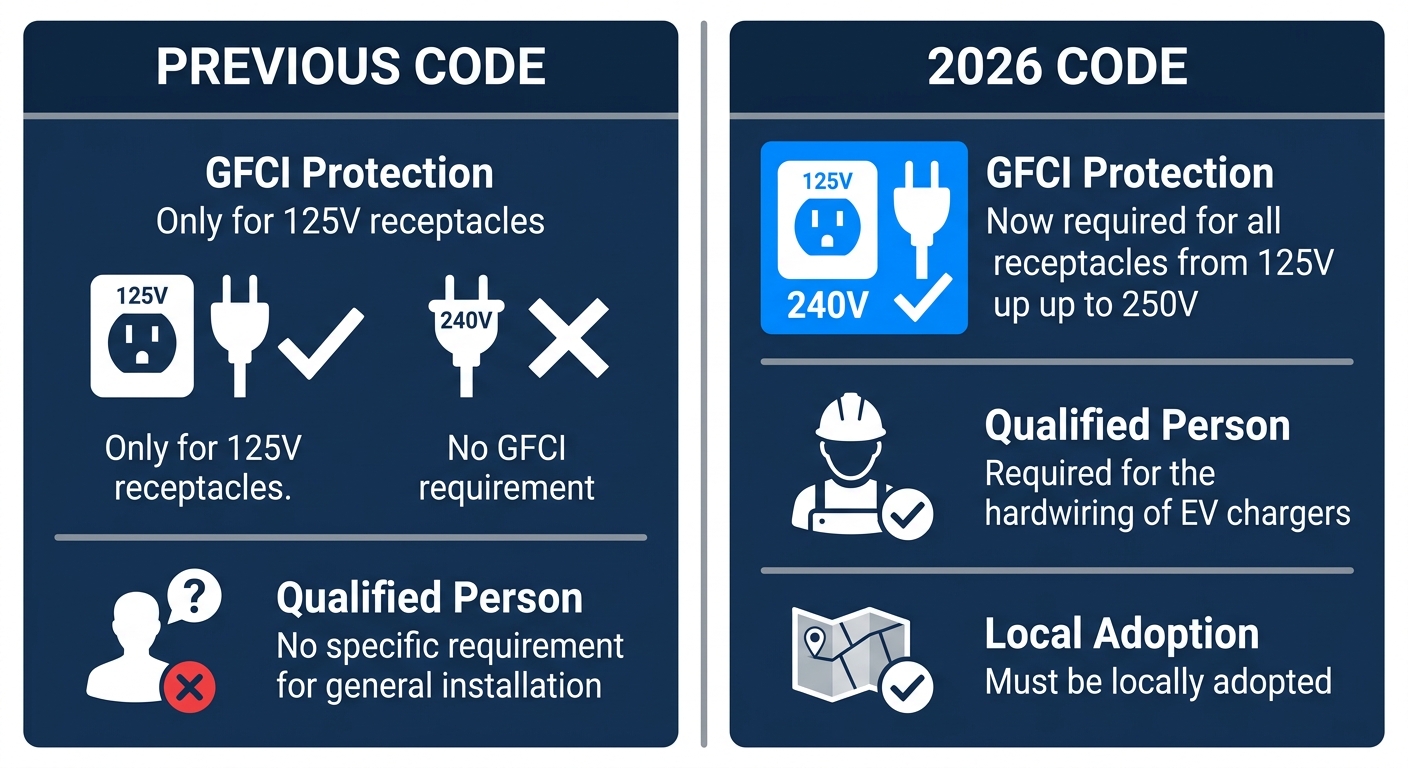
2026 NEC expands GFCI for EV chargers to all 125V-250V circuits.
Beyond GFCI, the 2026 code now requires that hardwired EVSE installations be done by a ‘qualified person.’ Previously, no formal qualification was specified, leaving the door open for untrained work. This rule limits DIY efforts and often means hiring a licensed electrician — a move that improves safety and ensures proper load calculations. Local AHJs in the San Fernando Valley may also mandate hardwired connections instead of plug-in units; hardwiring removes a connection point, increasing long-term reliability. When combined with the GFCI expansion, these changes create a much safer charging environment for your home. While NEC does not universally require permits for EVSE, the 2026 edition strongly encourages AHJs to enforce them. Our team handles the permit applications and scheduling, so you can focus on enjoying your charger.
Understanding these code changes is the first step; in the next section, we’ll examine why professional installation is essential to safety and compliance. At Electricians Team Reseda, we are licensed and insured, and we stay current with every NEC update to deliver safe, code-compliant work. For a complete walkthrough of the process, our home EV charger installation guide details each step from site assessment to final inspection. We provide free written estimates before we start, so you know exactly what to expect. Our goal is to ensure your EV charging setup is safe, reliable, and fully compliant with the latest standards. Please consult a licensed electrician for professional advice and a site-specific assessment.
GFCI Protection and Circuit Requirements Under NEC 2026
Now that the broader NEC 2026 updates are clear, we focus on the precise GFCI and circuit rules for residential EV charger installations. Homeowners planning an EV charger installation in Reseda or across the San Fernando Valley need to grasp the NEC 2026 EV charger requirements for ground-fault circuit interrupter (GFCI) protection and the qualifications required for safe, code-compliant work.
When GFCI Protection Applies to EV Circuits
The 2026 National Electrical Code significantly expands GFCI mandates for EV charging equipment. Our licensed electricians at Electricians Team Reseda stay current with these updates to protect your family and property. Under NEC 2026, GFCI protection is required for all 125-volt and 240-volt receptacles intended for EV charging, regardless of whether the outlet is located in a finished or unfinished garage, a carport, or an outdoor setting. This means that even a Level 1 (120-volt) trickle charger plugged into a garage wall must have GFCI protection. For hardwired Level 2 chargers, the code may exempt the circuit if the manufacturer’s instructions specifically state that the equipment includes internal ground-fault protection; however, many California adopting agencies still require a GFCI breaker, so it’s essential to verify local amendments. The expanded rules also catch EV charging outlets in laundry rooms and basements — any receptacle in those areas now needs GFCI, removing the prior sink-proximity exception. These NEC 2026 EV charger requirements underscore the importance of modern GFCI technology in preventing shock hazards in everyday EV use.
Hardwired vs. Plug-In: 2026 Mandates and Considerations
While the 2026 NEC does not explicitly mandate hardwiring Level 2 EV chargers, California jurisdictions frequently interpret the code to require a hardwired connection in new construction. This stems from concerns over nuisance tripping when the appliance’s internal ground-fault detection interacts with a GFCI-protected receptacle, and from a broader push for permanent, tamper-resistant installations. Plug-in chargers remain permissible provided the receptacle is GFCI-protected, is installed by a qualified individual, and meets all local amendments. Still, many inspectors in the San Fernando Valley lean toward hardwired setups to eliminate points of failure, so a site assessment by Electricians Team Reseda can clarify which approach will satisfy your local building official and keep your project on track.
Understanding the Qualified Person Requirement
NEC 2026 defines a qualified person as an individual with the skills and knowledge to safely perform electrical construction and maintenance. In California, the California Contractor License Board sets the bar: only licensed electrical contractors may legally perform installations that require pulling permits, and they carry the insurance and bonding that protect homeowners. Choosing a CSLB-licensed electrician for your EV charger project ensures liability coverage and helps avoid insurance disputes if an accident occurs. Your family’s safety and security is our top priority — we urge Reseda homeowners to always work with a licensed professional for any new EV circuit. Please consult a licensed electrician for professional advice and a site-specific assessment (individual job results and scope may vary).
Hiring a Licensed Electrician in Reseda: Navigating Qualified Person Requirements and Permits
Now that you understand the basics of EV charging at home, let’s discuss the critical requirements for hiring a licensed electrician in Reseda under the upcoming NEC 2026 EV charger requirements. These code updates clarify which installation tasks homeowners can handle themselves and which demand the expertise of a qualified professional. Understanding these distinctions is essential for a safe, compliant, and future-proof charging setup.
Can a Homeowner Install a Level 2 Charger Under 2026 Codes?
Under the 2026 NEC code, a non-licensed person may still replace an existing receptacle or install a cord-and-plug-connected Level 1 charger on an existing circuit. However, installing a new dedicated circuit or hardwiring a Level 2 charger generally requires a qualified person—specifically, a licensed electrician. The NEC 2026 mandates GFCI protection for EV charger circuits to reduce shock hazards, a safety measure that demands professional wiring and load calculations. Homeowners who attempt this work without proper training risk code violations, inspection failures, and dangerous electrical faults.
Our licensed electricians in the Reseda area understand the nuances of both national and local Los Angeles codes. We provide free written estimates before we start, so you know exactly what your installation involves. We never cut corners when it comes to your safety. Trying to self-install a hardwired Level 2 station can void manufacturer warranties and insurance coverage. With Electricians Team Reseda, you avoid these pitfalls.
The following table breaks down the critical differences between a DIY approach and a professional installation:
| Feature | Previous Code | 2026 Code Update |
|---|---|---|
| GFCI Protection | 125V in garages only | All EV circuits (125V-250V) |
| Installer Rules | Vague / DIY allowed | Qualified Person mandated for hardwired |
| Permitting | Local discretion | NEC strongly encourages AHJ enforcement |
Steps for a Code-Compliant EV Charger Installation in Reseda
- Contact Electricians Team Reseda for a free written estimate and site assessment. We assess your electrical panel capacity, existing wiring, and ideal charger location—all at no cost.
- Obtain necessary permits. For new circuits and hardwired Level 2 chargers, permits are mandatory. Our team manages all permit applications on your behalf, ensuring compliance with NEC 2026 EV charger requirements and local Reseda codes.
- Professional installation with GFCI protection per code. A licensed electrician installs the dedicated circuit, hardwires the charger, and integrates the required GFCI protection to meet 2026 safety standards.
- Permit inspection. After installation, the city inspects the work. We coordinate the inspection and address any final adjustments, so you don’t have to.
- Enjoy safe, code-compliant charging. Charge your EV with confidence, knowing the work meets all safety regulations and is backed by our workmanship guarantee.
Why Professional Installation Matters for Safety and Code Compliance
When you choose Electricians Team Reseda, you’re not just hiring an electrician—you’re gaining a partner committed to your safety and satisfaction. We are on time, every time—guaranteed. We respect your schedule and your home: Your house will be left clean and neat. Our licensed and insured electricians bring deep knowledge of Los Angeles and San Fernando Valley codes, which means every installation is code-compliant and built to last.
We emphasize a transparent, no-surprises approach. We provide free written estimates before we start, so you know the scope and cost from day one. With clear upfront pricing and no hidden fees, you can plan your project with confidence. And if anything isn’t right, our guaranteed workmanship stands behind every job.
Safety isn’t just a slogan; your family’s safety and security is our top priority. GFCI-protected circuits, proper load balancing, and meticulous workmanship keep your home and vehicle safe. Whether you need a straightforward Level 2 installation or a complete panel upgrade, we deliver fast, professional, and affordable electrical services that meet the rigors of the 2026 NEC.
Advanced Compliance Considerations for EV Charging Systems in Reseda
Beyond the basics, advanced compliance considerations come into play with the 2026 NEC code updates. Understanding the NEC 2026 EV charger requirements is essential for Reseda property owners installing or upgrading charging stations. The table below outlines how GFCI protection and qualified-person mandates differ by charger type under the upcoming code, helping you plan a safe, compliant installation.
2026 Code Requirements by Charger Type
| Scenario | 2026 GFCI | Installer Qualification |
|---|---|---|
| Level 2 Hardwired | Required | Qualified person required |
| Level 2 Plug-In | Required (Receptacle) | Licensed electrician recommended |
| Level 1 Outdoor | Required | Licensed for new circuit |
Why DC Fast Charging Slows at 80%
One important performance consideration is that EV charging slows at 80 percent due to battery management system protections. After 80%, the charging rate drops significantly to protect lithium-ion cells and manage heat, often making the final 20 percent take as long as the first 80 percent.
Common Questions About NEC 2026 EV Charger Requirements in Reseda
Do I need GFCI protection for my EV charger?
Under the NEC 2026 EV charger requirements, Electricians Team Reseda confirms GFCI protection is now mandatory for all 125V–250V receptacles used for EV charging in Reseda garages and outdoors.
Will I need a panel upgrade?
A panel upgrade may be required if your existing panel cannot handle the extra load. A licensed electrician can assess your panel capacity.
Are permits required for EV charger installations in Reseda?
Yes, permits are typically required for EV charger installations in Reseda. Our team handles the entire permitting process, and we provide clear upfront pricing and free written estimates.
Ensure Your EV Charger Installation Meets the Latest Code in Reseda
To ensure your EV charger installation meets the latest code in Reseda, you must keep pace with the NEC 2026 EV charger requirements that California adopts quickly. Our licensed electricians stay current with every update so your installation is safe and compliant. We provide free written estimates, and your family’s safety and security is our top priority. Contact Electricians Team Reseda for a code-compliant installation. Please consult a licensed electrician for professional advice and a site-specific assessment (individual job results and scope may vary).